

How do you support technical experts to transition to leadership roles where they have to do business development for the first time? How do you ensure that your middle managers are shaping the right culture throughout your organisation? How do you, as an analytical thinker who is most comfortable in financial models, start selling to protect your revenue in highly disrupted markets?
I have had several striking conversations recently with leaders from investment banking, professional services and real estate funds management. These conversations prompted me to revisit the principles that shape human decision-making.
Many B2B leaders rise to senior roles on the strength of their technical expertise. They have depth, rigour, and a reputation for sound judgement. And then, almost without warning, the job changes.
Suddenly, success is no longer about being right. It is about being chosen.
Chosen by clients. Chosen by internal stakeholders (junior and senior). Chosen for the next opportunity, the next investment, the next strategic mandate. Technical skills remain essential, but they are no longer sufficient. This is where many leaders encounter an uncomfortable word: selling (yourself). Yet what success actually depends on is not salesmanship.
It is something far more fundamental and far more leadership-oriented: Trust.
In B2B contexts, decisions are often framed as rational and evidence based. Stakeholders talk about technical competence, risk, governance, capability and pricing. While these factors can matter, they rarely explain the final decision. In practice, stakeholders choose people they trust…and then justify that decision with logic afterwards.
Trust can be understood through a simple equation, aptly named The Trust Equation, which first appeared in the book The Trusted Advisor, co-authored by David Maister, Charles Green and Robert Galford.
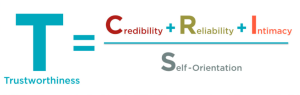
Trust = (Credibility + Reliability + Intimacy) ÷ Self-Orientation
- Credibility — Do I believe you know what you are talking about?
- Reliability — Do you do what you say you will do?
- Intimacy — Do I feel safe being candid with you?
- Self-orientation — Are you primarily focused on your gain or mine?
What erodes trust fastest is perceived self-interest. The moment a stakeholder feels they are being “sold to”, trust diminishes, even if the solution is excellent.
This applies equally internally and externally. If colleagues sense your agenda is personal advancement rather than shared outcomes, influence reduces. If a client senses you are pushing a predefined answer, confidence weakens. Trust is not built through persuasion. It is built through actions.
Selling Without Selling
Many technically oriented leaders dislike selling because they associate it with confidence theatre, self-promotion, or an extroverted style that does not feel authentic. But the most effective leaders are not the most performative. They are the most helpful. They approach influence with a proactive and curious mindset:
How can I help this person think differently, decide confidently, or deliver more efficiently?
That shift removes self-orientation. It changes the tone of conversations immediately. Instead of leading with credentials, they lead with curiosity. Instead of proving expertise, they demonstrate understanding. Instead of pitching solutions, they clarify what matters most to the client. There is a calm authority in leaders who are not trying to impress. They are trying to understand. And understanding builds the most underestimated element of trust: intimacy.
The Discipline of Intimacy
Intimacy in leadership is not over-sharing or forced friendliness. It is psychological safety in all interactions.
It is the sense that:
- I can speak openly here
- I won’t be judged
- My context is being taken seriously
- My concerns will not be used against me.
This matters in short interactions as much as long-term relationships. Many stakeholders will form a view in the first 15 minutes, not based on your technical expertise, but on whether you seem self-oriented or genuinely committed to their success.
Building intimacy does not require a lot of time. It requires disciplined curiosity and empathy.
A few questions consistently create depth:
- What is most challenging for you right now?
- What are you seeing that others may not be seeing?
- What does success look like from your perspective?
- What do you need from me to make progress?
When leaders prepare thoughtful questions and genuinely listen to the answers, they increase intimacy without sacrificing efficiency. The irony is that the person asking the questions often does less talking yet leaves the stronger impression.
Authenticity Is About Consistency, Not Personality
A common tension that often arises is, leaders are told to “be authentic” and “build relationships”, but not everyone is naturally relational, expressive, or socially energised. So how can they be authentic in demonstrating extroversion if they are a deep introvert? This is where the confusion emerges for leaders. Building trusted, safe relationships does not mean being extroverted. It means being authentic.
Leaders need to be clear on their answer to these three questions:
- What do I stand for in this role?
- What genuinely motivates me about this work?
- What values will guide my decisions under pressure?
When leaders are clear on these anchors, they can lead authentically. They consistently share and demonstrate how their decisions and their actions align with their key personal values. Team members and peers experience coherence between words and actions, and this builds credibility and reliability.
You do not need to become someone else to build trust. But you do need to be intentional about who you are.
If your team members understand your personal drivers and if they see you act in accordance with this compass, it fosters their trust. They know and can predict how you will behave, react and decide. When you make a mistake or react in a way that is not your best self, they will forgive you because they understand the values that drove you in that moment. In a world where leaders constantly operate under pressure, the most critical element of talent attraction, retention and performance, is the capacity to generate trust.
This is not achieved by leaders being everyone’s best friends. It requires them to be clear about their core personal values and be prepared to share them openly, and consistently.
Competing Without Self-Promotion
In many B2B cultures, leaders are encouraged to “credentialise”, to demonstrate capability through case studies, track record, and proof. The challenge is that over-credentialising can feel like self-interest. It can trigger scepticism: Are you trying to help me, or win something from me?
A better path is storytelling.
High-trust leaders share anonymised stories of impact, not as a sales pitch, but as a way to share their passion and their learning:
- What challenge was faced?
- What tension needed to be navigated?
- What choices were made, and why?
- What shifted as a result?
Storytelling communicates depth and value without self-promotion. It invites the stakeholder into your thinking process rather than asking them to accept your claims. Over time, this builds both credibility and intimacy.
Focus on building trust and the rest will come naturally.
Perhaps the most overlooked strategy is this: treat relationship-building as part of the work.
Trust is built through small, repeated interactions:
- ask thoughtful questions that seek to understand your stakeholders deeply
- listen twice as much as talking (two ears, one mouth)
- share what matters to you (through genuine stories)
- explain your personal values and drivers whenever you make decisions, are unsure or make a mistake.
It compounds quietly, often long before the formal “pitch moment” arrives. And when that moment does come, whether it’s a client proposal, a resourcing decision, an internal investment request, or a strategic recommendation, the outcome will reflect the level of trust that was built.
Because in the end, stakeholders do not choose technical brilliance. They choose judgement they can trust.